Northern Lights in Scotland
Go north, wait for a clear, moonless winter night and watch the alerts: how to give yourself the best chance of seeing the Mirrie Dancers.
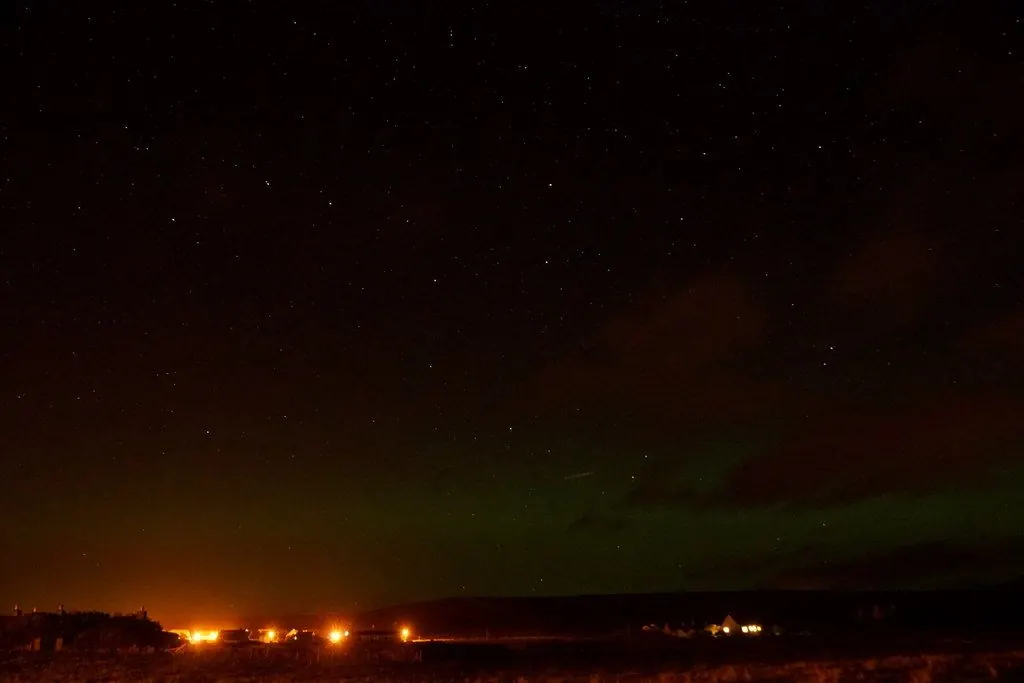
Your best chance of seeing the Northern Lights in Scotland comes on a clear, dark night between October and March, as far north as you can get and well away from artificial light. Shetland, Orkney, Caithness and the Outer Hebrides lead the list, but on a strong night the aurora can be seen right across the country.
Where to Look
Northern Lights are more frequent the further north you go. Shetland, lying at around 60 degrees north, is described by VisitScotland as "the closest part of Scotland to the Arctic Circle". Orkney has very dark skies over coasts such as Birsay and Yesnaby, while Lewis and Harris in the Outer Hebrides offer the clear northern horizons that matter most. On the mainland, Caithness and the north coast of Sutherland give the same open views without a ferry, and the Cairngorms National Park is often drier and clearer than the west. Further south, Galloway Forest Park, the UK's first Dark Sky Park, is a good choice when activity is high.
Wherever you go, what counts is a view to the north with no town glow in the way. North-facing coastlines, sea cliffs and open moorland all work well, and in Shetland visitors are advised to get away from the lights of Lerwick.
When to Try
The dark months are the season. VisitScotland suggests October to March, when nights are long, and Shetland.org says aurorae are most likely to be seen between mid-October and mid-March. VisitScotland gives roughly 9pm to 2am as the typical viewing window. In the light summer nights of the far north the sky rarely gets dark enough.
Every night is different. A clear sky is essential: as Shetland.org puts it, even if the aurora is present, thick cloud may stop you seeing it. Moonlight and light pollution wash out faint displays, so nights around the full moon are the weakest choice.
Alerts, Cameras and the Mirrie Dancers
AuroraWatch UK, a free service run by scientists at Lancaster University, measures geomagnetic activity and sends alerts by email and social media. Its levels run from green to red: at yellow, aurora may be visible by eye from Scotland, and at amber it is likely to be visible by eye from Scotland, northern England and Northern Ireland. The service is clear that an alert is not a promise, as local conditions still need to be right. The Met Office also publishes a space weather forecast; it suggests checking the Kp index, a scale from 0 to 9 on which a higher number means a better chance, subject always to cloud cover.
A camera often sees more than your eyes do. Faint aurora can look like a grey or white glow to the eye, while a phone or camera on a long exposure picks up the green and red. The Met Office notes that almost anyone with a smartphone or digital camera can photograph the aurora; a tripod or steady surface helps.
Locals in Shetland call the Northern Lights the "Mirrie Dancers", a name for the way the lights move and shimmer across the sky. Tourism bodies are clear that a sighting cannot be guaranteed on a short stay, so the practical approach is to go north in the dark months, plan other things to do, keep an eye on the alerts and the cloud forecast, and be ready to head out at short notice. Dress for a long, cold wait.